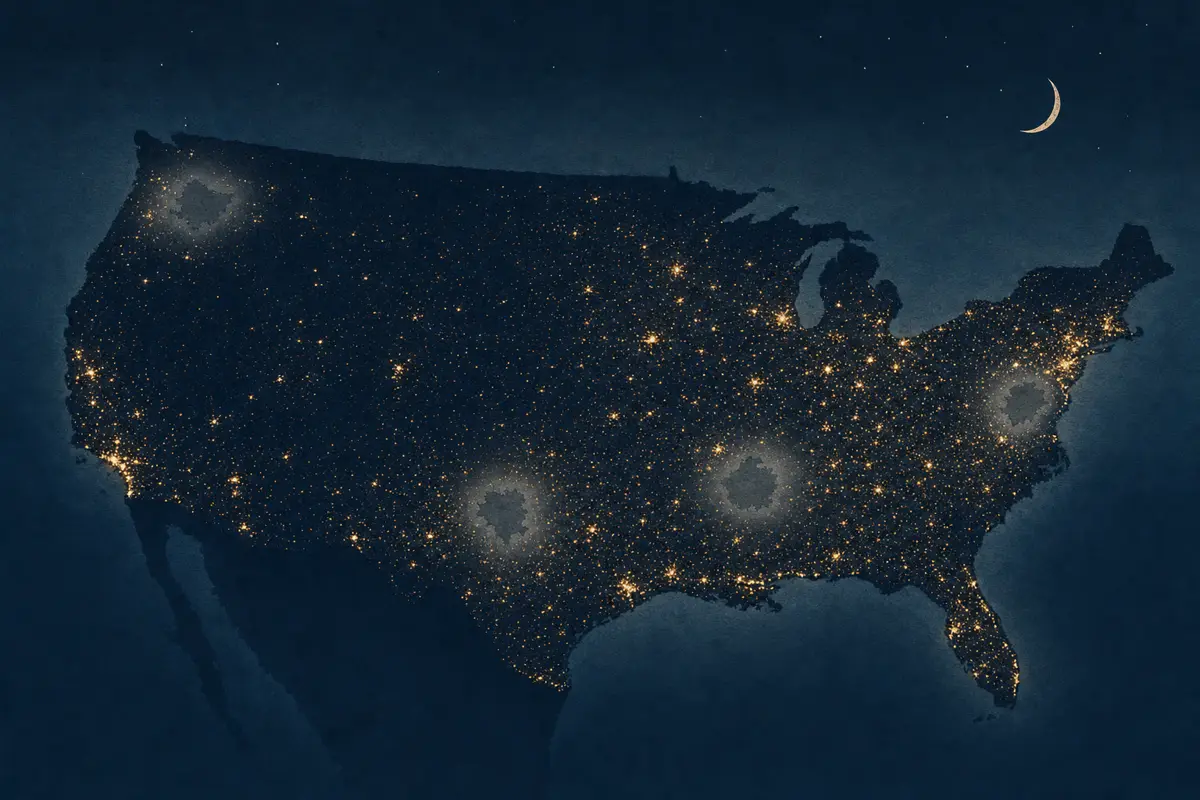
On the afternoon of November 13, 2026, the Federal Aviation Administration did something it had done only once before since September 11, 2001: it stopped every departing flight in the country. More than 3,500 planes were already in the air. They all landed safely, but by the end of the day operators had canceled roughly 12,462 flights.
That ground stop was the middle of four high-profile failures in six days. Microsoft 365 went down for almost a full day before it. Chase’s transaction processing stalled three days after it. The NSA’s classified internal network went down the day after that. By November 18, the House Homeland Security Committee was asking the country’s top security officials whether the United States was under attack. This post explains what actually broke in each of the November 2026 outages, which theories the evidence supports, and which it doesn’t.
Key takeaways
- Four separate systems failed between November 12 and 17, 2026: Microsoft 365, the FAA’s telecom network, JPMorgan Chase transactions and the NSA’s classified network.
- Each failure has its own documented technical cause: a software defect, a router installation, an on-premises bug and scheduled maintenance.
- U.S. intelligence, DHS and the FBI say they found no sign of a coordinated cyberattack, Iranian involvement or a common faulty patch.
- Federal staffing cuts are real, but no evidence ties them directly to these four failures.
- What the four do share is a risk profile: complex systems being changed faster than their testing and fallback plans were built for.
What actually broke between November 12 and 17?
The phrase going around social media was a “two-week meltdown.” The real cluster is narrower: four incidents over six days. Other failures in the same weeks (at United Airlines, Apple, Workday and AWS) made the pattern feel bigger, and Axios reported that bot accounts amplified theories linking everything together. But those other incidents haven’t been shown to share anything with the core four.
Here is what each organization has said about its own failure.
| Date | What failed | How long / how bad | Stated cause |
|---|---|---|---|
| Nov. 12–13 | Microsoft 365 (Exchange Online first, then Teams, Copilot, SharePoint, OneDrive and more) | 23 hours 50 minutes of customer impact | A software defect introduced in July, exposed by a traffic shift and reduced server capacity |
| Nov. 13 | FAA telecom network, leading to a nationwide ground stop | About 4.75 hours; 17 of 22 en-route control centers affected | A flood of network traffic linked to a new router being installed during a copper-to-fiber upgrade |
| Nov. 16 | JPMorgan Chase transaction processing | Monday morning until about 6:30 p.m. ET | A software bug in an on-premises hardware system |
| Nov. 17 | NSANet, the NSA’s classified internal network | Not disclosed | “Temporary degradation during scheduled routine maintenance” |
Microsoft: a hidden bug and a cascade
Microsoft’s incident is the best documented, because the company published a preliminary post-incident report. The story reads like a textbook case of how modern systems fail.
A code change that began rolling out in July contained a latent defect, a bug that sits quietly until the right conditions appear. Normal testing missed it. Then, early on November 12, automated failover moved Teams traffic onto gateway servers shared with Exchange Online. At the same time, nearly 14% of that gateway capacity was already offline because of an unrelated problem the day before.
The extra load triggered the bug. As servers failed, the system did what it was designed to do: it redirected traffic to the surviving servers. That pushed them over too. At the worst point, more than 80% of the relevant servers were unresponsive. The safety mechanism became the accelerant.
The FAA: one router, one very old network
The FAA’s own Q&A on the ground stop describes a different kind of failure. At about 3:30 p.m. ET, instability spread across 17 of the 22 Air Route Traffic Control Centers, the facilities that handle planes at cruising altitude. The network was being hit with about 1,000 connection attempts every four to five seconds.
Investigators traced the traffic to a radar site in Amarillo, Texas, and a radio site in El Dorado, Arkansas. At El Dorado, the FAA’s network contractor, L3Harris, had been installing a new Juniper router as part of a move from copper lines to fiber. Once L3Harris blocked the two sites, the network stabilized. The FAA lifted the ground stop at 8:15 p.m., disabled the same broadcasting feature on more than 60 other new routers and paused further installations.
What’s established is the mechanism: new equipment flooded an old network. What’s still under investigation is why, whether the router itself was faulty or the installation was misconfigured.
Chase: a bank outage that looked bigger than it was
On Monday, November 16, Chase customers started seeing failed or delayed transactions online and at some branches. That afternoon, Chase said it had a software bug in an on-premise hardware system, that the problem wasn’t “cyber-related,” and that transactions were posting normally by about 6:30 p.m.
The reason it felt like a banking-system outage is that money moves between banks. When Chase was on the other side of a payment, customers at U.S. Bank, PNC and others saw delays too. Those banks said their own systems were working. No federal financial regulator treated it as a stability emergency.
The NSA: the least transparent failure
On November 17, the NSA’s classified network went down. CBS News reported that the agency staggered arrival times at its Fort Meade headquarters so that thousands of employees wouldn’t log in at once while the network recovered. The NSA called it a “temporary degradation during scheduled routine maintenance” and said mission-critical capabilities stayed operational through backup systems. Officials who spoke to reporters said routine patching was involved.
The NSA hasn’t published a root-cause report, and given the classified setting, a detailed public one is unlikely. That makes it the hardest of the four to check independently.
Were the November 2026 outages connected?
“Connected” can mean three different things, and the evidence points in different directions for each.
1. One coordinated attack. This is the least supported explanation. All four organizations reported technical causes, not malicious ones. At the November 18 hearing, DNI Jay Clayton said the outages “are not a coordinated or state-sponsored attack,” and FBI Deputy Director Christopher Raia said there was “no indication whatsoever” of malicious cyber activity. DHS Secretary Markwayne Mullin put his confidence at 98%. He also admitted he had never seen this many outages in so short a time.
2. One common technical trigger, such as a single bad patch from one vendor. This isn’t supported either. Microsoft’s trigger was a gateway software defect. The FAA’s was physical network equipment. Chase’s was internal. The NSA’s was scheduled maintenance. Former CISA director Chris Krebs said there was no evidence of a common patch or backend upgrade tying them together.
3. A shared environment. This one is plausible. All four are large, highly interconnected systems that were being changed, upgraded or patched when they failed. That’s the sense in which the outages can be independent in cause but related in risk.
It also helps explain the coincidence. Four unrelated failures in a week isn’t evidence of sabotage if thousands of critical systems are all undergoing more change than usual at the same time.
Which explanations hold up?
The research behind this post weighed every major theory circulating in the days after. Here’s where the evidence stands as of November 20.
| Theory | What the evidence shows | Verdict |
|---|---|---|
| A coordinated cyberattack | No intrusion, malware, data theft or shared indicators reported by any of the four, or by U.S. intelligence | Very unlikely |
| Iran was behind it | Iran is actively targeting U.S. infrastructure, but officials explicitly separated that activity from these outages | Very unlikely on public evidence |
| Aging infrastructure | Clearly true for the FAA; Microsoft’s problem was new code, not old hardware | Strong for FAA, partial elsewhere |
| Mid-November patch season | November 10 was Microsoft’s Patch Tuesday, and companies rush changes before holiday freezes, but Microsoft’s bug dated to July | Background context, not a cause |
| AI is forcing faster patching | Officials and experts say AI tools are surfacing vulnerabilities faster than teams can safely test fixes | Plausible as a trend, unproven for these four |
| DOGE staffing cuts | Cuts are real and large, but no technical chain links them to these failures | Unproven as a direct cause |
The Iran theory: a real threat, the wrong suspect
The Iran theory spread partly because of timing. The House Homeland Security Committee hearing on November 18 was its annual worldwide-threats hearing, and Iranian threats were on the agenda. Officials testified that Iran and Iran-linked hackers have targeted U.S. transportation, finance, energy, health and water systems. But Secretary Mullin said those operations weren’t behind the outage cluster, and no public evidence links Iran to any of the four failures.
The patching theory: the most interesting explanation
The most thoughtful answer to “why all at once?” came from officials and security experts, as NPR reported. AI tools can now scan code and infrastructure for vulnerabilities far faster than before. That creates pressure to patch more systems, more often. Krebs and Sen. Mark Warner argued that the teams applying those changes haven’t expanded their testing and rollback capacity at the same pace.
The White House statement from Clayton and Secretary of State Marco Rubio framed it the same way: companies are fixing security flaws and modernizing old systems, and some systems don’t restart cleanly when they hand work off to others.
It’s a compelling idea, but it’s a hypothesis about the environment. Nobody has shown that a rushed patch caused any one of these four failures.
The DOGE theory: real cuts, missing link
Federal workforce reductions are not in dispute. The Government Accountability Office found that the civilian workforce at 22 major agencies fell by nearly 256,000 people, more than 11%, between December 2024 and January 2026. CISA lost roughly a third of its staff. The NSA reportedly cut about 2,000 people in 2025. It’s fair to ask whether agencies now have less redundancy and less institutional memory.
The specific claim that DOGE fired the technicians who maintain the equipment that failed doesn’t hold up, though. The FAA says air traffic controllers were exempt from probationary firings, and the specialists who maintain its navigation and communications gear weren’t among those let go. The November 13 work was being done by a contractor, L3Harris. PolitiFact concluded that the staffing numbers in one congressman’s claim were broadly plausible, but that tying them to the ground stop was speculative.
Supporters of the cuts argue that a leaner government isn’t a less capable one. Critics argue that resilience depends on spare capacity that cuts remove. Both can be debated on the merits, but these four outages don’t settle the argument.
How did the government respond?
The FAA’s response mattered most, because lives were at stake. Rather than keep departures going on a degraded network, it stopped them. Backup procedures let controllers track and talk to the 3,500 planes already flying until they landed, and the agency waited for sustained stability before reopening the skies. Transportation Secretary Sean Duffy asked the FBI to help examine the suspect router even after intelligence agencies said they didn’t think it was a hack. That was a precaution taken because of what happened, not a sign that investigators had found anything hostile.
Within days, the Department of Transportation used the outage to renew its request for $50.1 billion to build a fully modernized air traffic control system, on top of $12.5 billion already approved. The GAO had warned in September that the FAA’s accelerated modernization plan risked putting speed ahead of a mature schedule and cost plan, which is a useful reminder that modernizing old systems carries risks of its own.
Chase’s problem stayed a private-sector matter, and the NSA handled its own outage through backup systems and modified work schedules rather than a public emergency.
What this means for you
The most defensible reading of the November 2026 outages is not a hidden enemy. It’s that several critical systems broke on their own, close together, while they were being changed. That’s arguably harder to fix than an attack, because there’s no adversary to catch.
For most people, the practical lessons are modest but real:
- Keep a fallback for the services you can’t live without. A second way to pay (a card from a different bank, some cash), a second way to reach people if your work email is down, and offline copies of travel documents.
- Be skeptical of “it’s all connected” stories in the first 48 hours. In this cluster, the companies’ and agencies’ own technical explanations arrived within a day or two, and they were more specific than the viral theories.
- Watch the follow-ups, not just the headlines. The FAA and NSA investigations are still open. If either finds something new, it will appear in a root-cause report, not a trending post.
The bigger question this week raised isn’t who attacked us. It’s whether the pace of patching and modernizing has started to outrun our ability to test changes and build backups that really are independent. That question will outlast this particular week.
Further reading
- FAA: Nationwide Ground Stop — Questions and Answers — the FAA’s own timeline, figures and initial findings.
- Microsoft 365 preliminary post-incident report — the clearest technical account of any of the four failures.
- White House: DNI Clayton and Secretary Rubio on recent tech outages — the administration’s attribution statement.
- CBS News: “No indication” outages are related to coordinated cyberattacks — what officials told the House Homeland Security Committee.
- NPR: What’s going on with all the tech outages? — the accelerated-patching explanation.
- GAO: Federal Agency Workforce Changes, July 2025 to January 2026 — the official numbers on federal staffing cuts.
- GAO: Air Traffic Control Systems modernization — why the FAA’s network is fragile and what upgrading it involves.
- PolitiFact: Fact-checking the blame game over the FAA ground stop — sorting the partisan claims.